
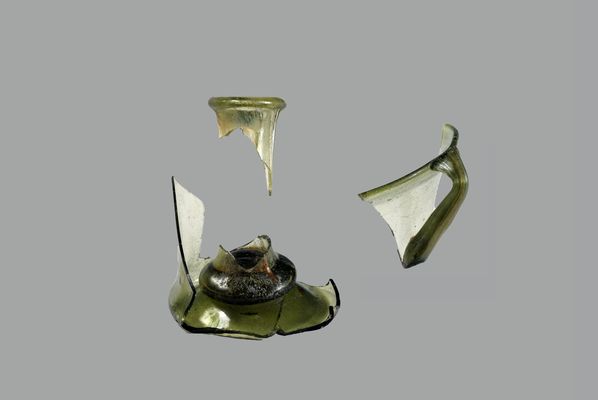
Partially surviving glass lamp. Part of the base, the rim of the vial and the rim of the lamp with one handle are preserved. It was discovered in 1995 during the Makrygiannis plot excavation, in Well Μ 10.
Made from green glass, it consists of an open cup and a separate cylindrical vial adjusted on its bottom. The vial was filled with oil and received the wick that was secured in an upright position by a metal or clay component. The cup was filled with water that acted as insulation, thus protecting the fragile vessel from overheating. From similar examples we know that the cup, apart from the surviving handle, would have had one more in order to suspend the lamp.
Lamps of this kind were among the first glass vessels that were manufactured during the late Roman period (3rd-4th cent. AD), exclusively for lighting purposes. The glass walls –more or less transparent- allowed the diffusion of light throughout the space and protected the flame from air drafts.